
Glossary term
Glossary term
Foundations
A mechanism for evaluating the quality of a decision forest by testing each decision tree against the examples not used during training of that decision tree. For example, in the following diagram, notice that the system trains each decision tree on about two-thirds of the examples and then evaluates against the remaining one-third of the examples.
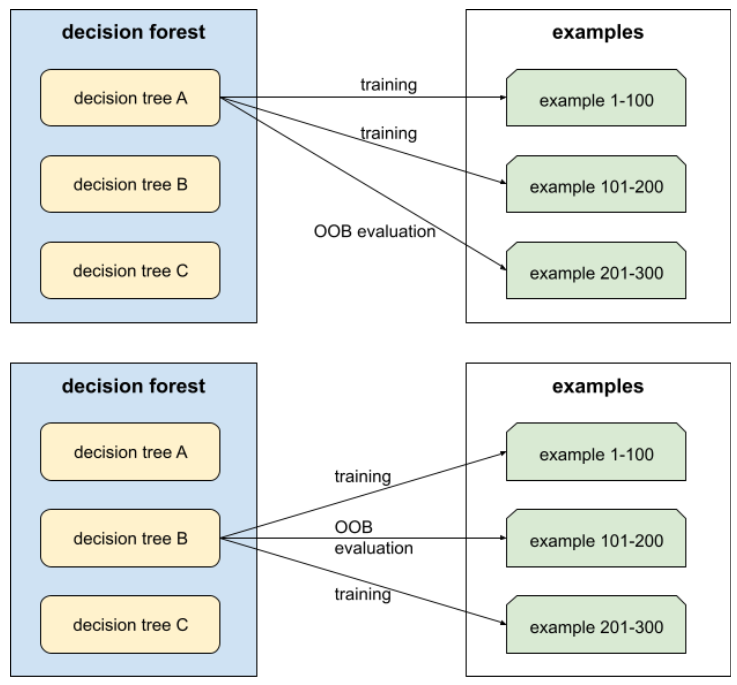
Out-of-bag evaluation is a computationally efficient and conservative approximation of the cross-validation mechanism. In cross-validation, one model is trained for each cross-validation round (for example, 10 models are trained in a 10-fold cross-validation). With OOB evaluation, a single model is trained. Because bagging withholds some data from each tree during training, OOB evaluation can use that data to approximate cross-validation.
See Out-of-bag evaluation in the Decision Forests course for more information.
Created for this library
A research team uses out-of-bag evaluation on its random forest to estimate generalization without a separate held-out split.
A risk modeling team uses OOB evaluation during early experiments to compare random forest configurations on small datasets.
A retail analytics team uses OOB evaluation as a quick check during training while preserving a held-out set for the final release decision.
Definition source: Google for Developers Machine Learning Glossary | Creative Commons Attribution 4.0 License