
Glossary term
Glossary term
Foundations
An intercept or offset from an origin. Bias is a parameter in machine learning models, which is symbolized by either of the following:
b
w0
For example, bias is the b in the following formula:
In a simple two-dimensional line, bias just means "y-intercept." For example, the bias of the line in the following illustration is 2.
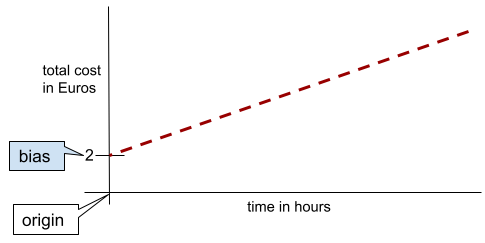
Bias exists because not all models start from the origin (0,0). For example, suppose an amusement park costs 2 Euros to enter and an additional 0.5 Euro for every hour a customer stays. Therefore, a model mapping the total cost has a bias of 2 because the lowest cost is 2 Euros.
Bias is not to be confused with bias in ethics and fairness or prediction bias.
See Linear Regression in Machine Learning Crash Course for more information.
For example, bias is the b in the following formula:
In a simple two-dimensional line, bias just means "y-intercept." For example, the bias of the line in the following illustration is 2.
Created for this library
A pricing team includes a bias term in its linear demand model so the intercept reflects baseline volume when all price covariates are zero.
A computer vision team initializes the bias term of the final classification layer using the class frequencies in the training set.
A risk modeling team enforces a fixed bias term in its logistic regression so the production model matches the calibration of the legacy scorecard.
Definition source: Google for Developers Machine Learning Glossary | Creative Commons Attribution 4.0 License